 The Villager Newspaper Online Your Community News – Cleveland's Westshore


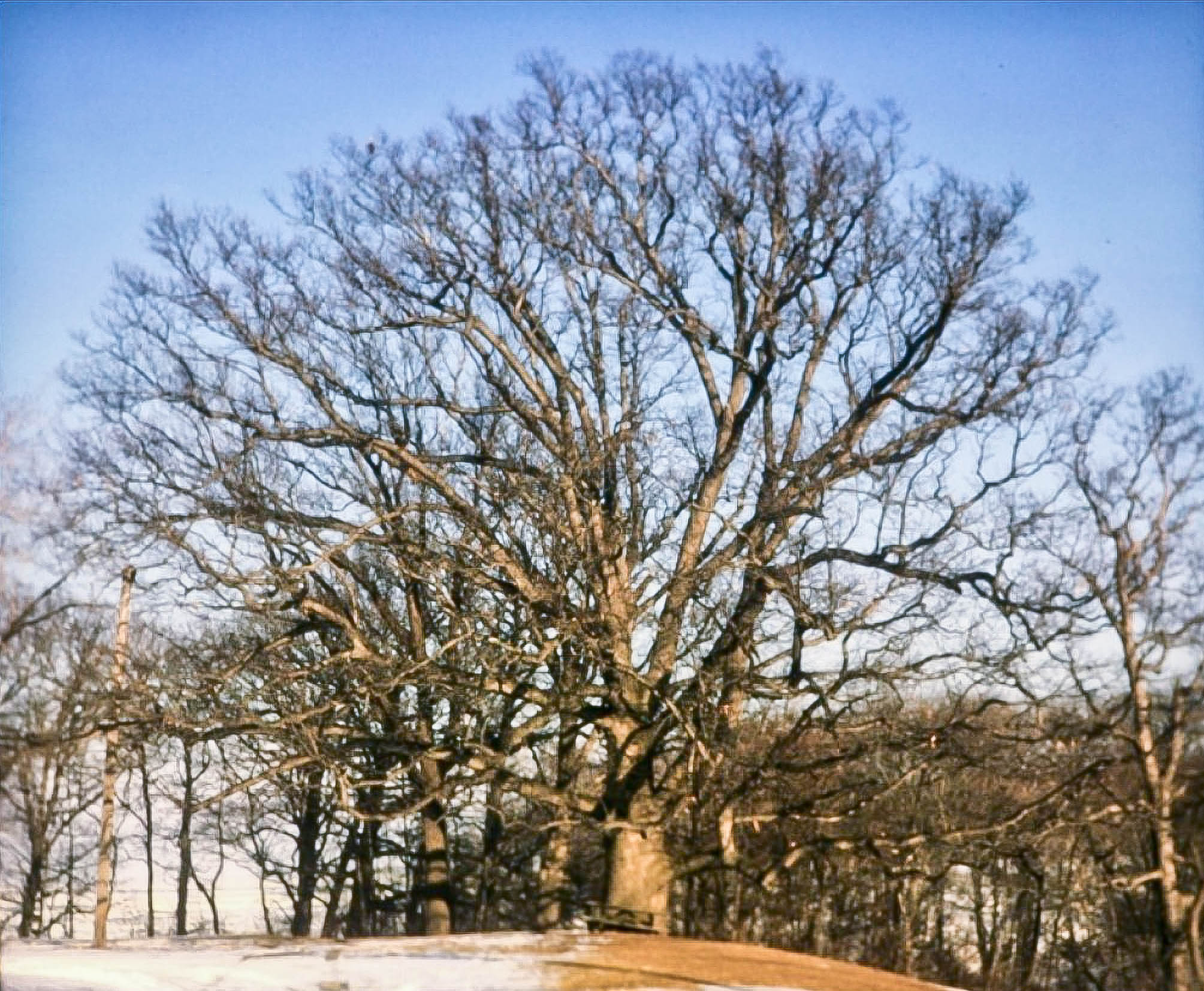
White oak in Cahoon Park, a potential Moses Cleaveland tree
By Walter Topp
Trees don’t just shade your house, cool your yard, reduce flooding, clean the air, and provide food for insects, birds, and other animals.
While trees – especially big trees – do these things, they can also define a community, said Dr. Roy Larick, a retired paleo-archeologist who serves as the Early Settler’s Association Moses Cleaveland Tree committee chair. Trees are living landmarks that create a sense of place that connects residents to the history of their community and can provide a tangible link to the future, he said.
‘Moses Cleaveland Trees’ are trees that have been designated in one of several county-wide surveys conducted between 1946 and 1986. They are highly visible links to the history of this area.
In 1796, when Moses Cleaveland and his surveyors first visited Northern Ohio, they encountered a trackless forest stretching unbroken for many miles.
By 1940, when the county’s population reached 1.2 million, agricultural, residential, and industrial development had destroyed virtually all of the original forest.
 But traces remained.
Here and there, spectacular mature trees survived. In 1946, to commemorate the 150th anniversary of Moses Cleaveland’s arrival, Arthur Williams, curator of education for the Cleveland Museum of Natural History, conducted a survey of remaining old-growth trees in the county with the aim of identifying 150 trees that had been alive in 1796.
Dubbed ‘Moses Cleaveland Trees,’ the designated trees were listed and identified with plaques.
Williams sought to include as many different tree species as he could, to better understand the make-up of the original forest, and he also sought trees that were visible from the public right-of-way, to serve as stately reminders of the region’s history.
The designated trees – each estimated to be more than 150 years old at the time of the survey – were among the last survivors of the original forest. Each had been spared when the trees around it were cleared, probably because they were in some way special to the landowner.
Of the first 150 Moses Cleaveland trees, four were located in Bay Village. By 2010, all four were gone.
In the years after 1946, the Moses Cleaveland trees faded from view. Many were removed as road and utility construction encroached on the rights-of-way. Others succumbed to disease, and some were destroyed by lightning or severe storms. Still others were removed by property owners.

White oak in Cahoon Park, a potential Moses Cleaveland tree
But in the 1970’s, as awareness of the environment grew, the Early Settler’s Association became interested in restarting the Moses Cleaveland tree program in advance of the 175th anniversary of Cleaveland’s arrival. Between 1979 and 1986 the Association conducted four additional surveys, identifying the original Moses Cleveland trees that remained and adding 120 more trees.
During those surveys, eleven more Bay Village trees were listed. Two of those trees – a white oak on West Oviatt Road and a hickory on Breezewood Drive – remain.
In the early 2020’s, a researcher named Kathryn Flinn reviewed survey reports prepared by the Connecticut Land Company’s original surveying teams between 1796 and 1807. Those reports identify the types of trees that were observed by surveyors as they ran township lines through the dense forest.
Flinn’s research, the original Moses Cleaveland tree survey in 1946, and anecdotal reports by descendants of early settlers collected by Arthur Williams, all combine to provide a detailed look at the forest as it existed before settlement.
That kind of information can be critical to efforts to reconstitute the urban forest and the urban tree canopy, said Larick. By knowing which trees were originally located in a certain area, we know which trees best belong there ecologically, he said.
 While Northern Ohio’s pre-settlement forest is described as a beech-maple forest, the woods also included large numbers of oaks, chestnut, elms, and sycamores. The topography and soil composition of the northwest lakeshore suburbs – including Bay Village, Rocky River, and Westlake – was especially suitable for various species of oaks.
But though interest in trees has grown in the past decades, the urban tree canopy continues to decline.
Bay Village Urban Forestry Manager Dave Robinson estimates that the city has lost nine percent of its tree canopy in the past decade. County officials report that Cuyahoga County’s tree cover decreased 6 percent from 2014 – 2019 and the City of Cleveland’s tree cover decreased by 5 percent.
Robinson reviewed county tree loss data and determined that Bay Village lost 234 acres of tree cover in the years 2011 – 2017. That’s about 177 football fields worth of trees, and likely numbers around 14,000 individual trees.
Since a large portion of Bay Village is comprised of the Metroparks reservation and Cahoon Park, where the tree canopy is managed and reduction is less, the loss of trees in residential and commercial areas is greater, probably exceeding 10 percent, said Robinson.
Larick believes that education can help slow and possibly reverse tree canopy loss.
One of the original Mose Cleaveland trees, nicknamed ‘Her Majesty,’ in Cahoon Park just west of Cahoon Creek, felled by a lightning strike in the 2010’s. (photo by Kay Laughlin)
To support education efforts, he is looking for a designating institution that can continue the work of the ESA and sponsor a new county-wide tree survey. He has already identified fifty additional Moses-Cleaveland-caliber trees that could be designated. Four of those trees are in Bay Village, and all are still standing. Two of those trees – both white oaks – are located in Cahoon Park south of Lake Road near Porter Creek and Cahoon Creek.
Currently fifteen Cuyahoga County communities, including Bay Village, have some type of tree board or commission, Larick said. He is working to bring these organizations together as a network of tree boards that can oversee further designations.
Larick hopes that the designation process will raise awareness of the past, present, and future value of canopy-type trees and encourage preservation by property owners and local governments. “People just like to see big old trees,” he said. “Both education and local ordinances have a role.”
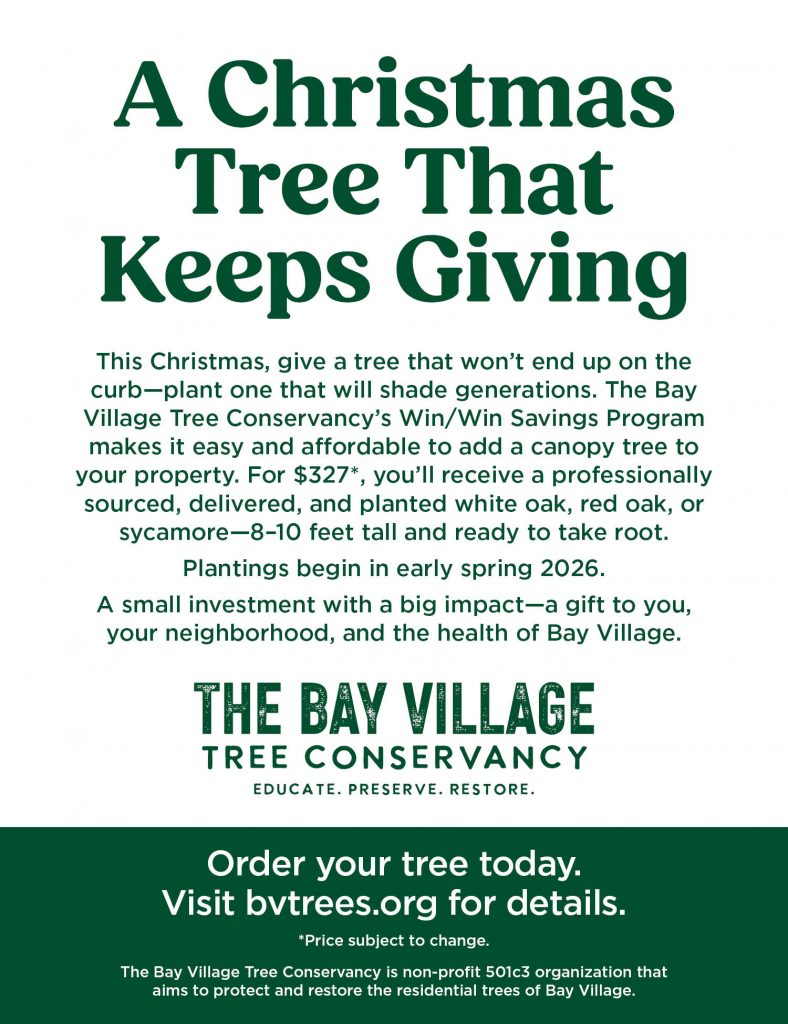
Citizen-led organizations like the Bay Village Tree Conservancy are especially well-suited to leading education efforts, said Larick.
“Our tree canopy is a wonderful thing,” he said. “It’s always changing. But tree canopies are living things, and they always need to be replaced.”