 The Villager Newspaper Online Your Community News – Cleveland's Westshore

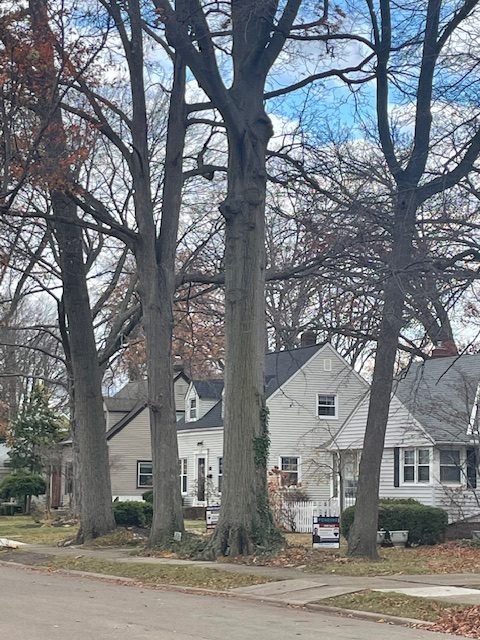
A disappearing pattern: These three oaks stand together, a rare grouping modern landscaping would rarely allow
I moved to Bay Village in 2002, into a modest corner house east of Dover. At the time, it was just me and my dog, and trees were everywhere. The street felt appropriately named Parkside—shaded, quiet, and full of character. Over the years, my life here grew. I met my husband, who lived down the street with his two daughters, and the rest is history.
Alongside those personal changes, I’ve watched something else change—slowly at first, and now at an alarming pace.
One by one, the trees have been disappearing.
We lost both of our Bartlett pear tree lawn trees to separate storms. A neighbor lost three mature maples to age. Another neighbor’s stately silver maple split safely in half one summer afternoon. The most heartbreaking loss came when nearly ten mature oaks were cut down to make way for construction on two oversized houses—on a property that now has no trees at all.
Since the most recent tornado, I’ve seen healthy trees removed out of fear. I’ve heard neighbors decline tree lawn plantings because they don’t want to deal with leaves. Each decision is understandable on its own. Taken together, they are reshaping the face of our city.
 One morning while walking our dog, I asked my husband if he felt it too—if it seemed like our street was losing its character. If it was strange that streets named Elmwood, Oakwood, and Forestview now felt increasingly bare. He mentioned speaking with a neighbor whose brother, along with a group of lifelong Bay residents, had started a tree conservancy for this very reason.
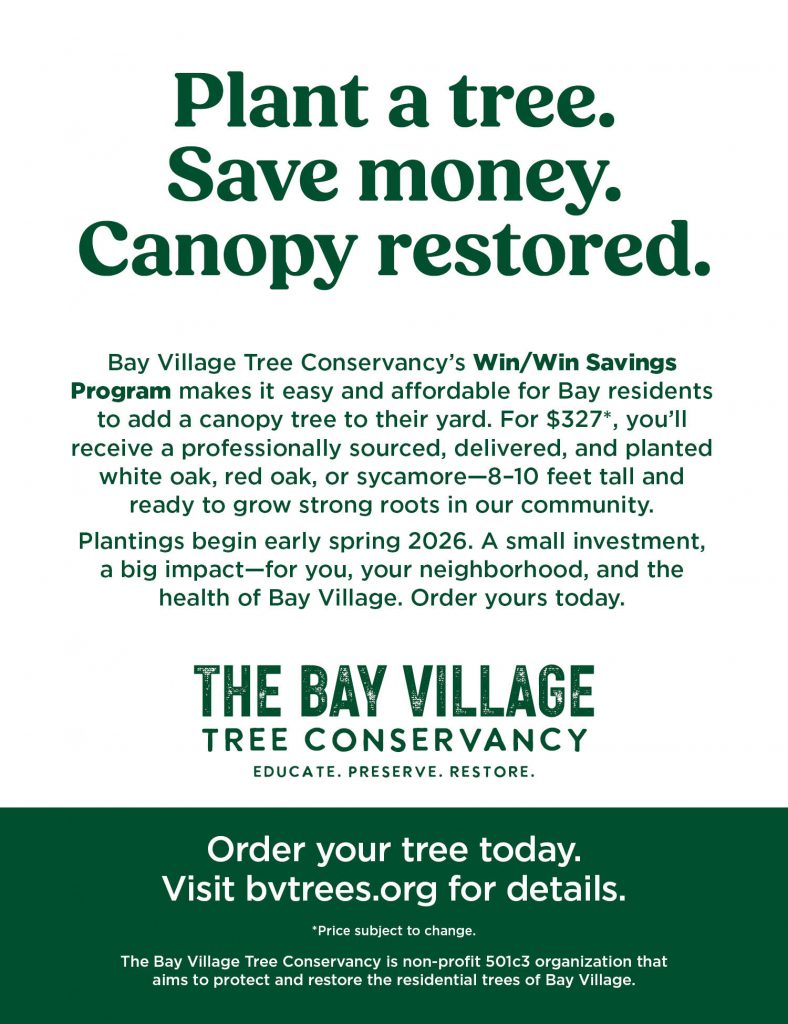
That conversation led me to the Bay Village Tree Conservancy (BVTC), where I now volunteer. In just two short years, our small group of like-minded residents has planted roughly 50 canopy-scale trees around town, launched a community tree-sale program, and handed out hundreds of saplings at each homecoming parade to raise awareness. It’s a meaningful start—but it’s not enough without broader community participation.
What’s been hardest is seeing how reluctant we’ve become to replant.
Bay was built on modest homes and generous green space, where trees were allowed to grow and age naturally. That’s why some yards still boast five towering oaks. But when those trees are lost—and not replaced—the landscape changes permanently. I understand the hesitation: concerns about space, age, maintenance, or cost. They’re all valid. But if everyone opts out, the cumulative effect is devastating.
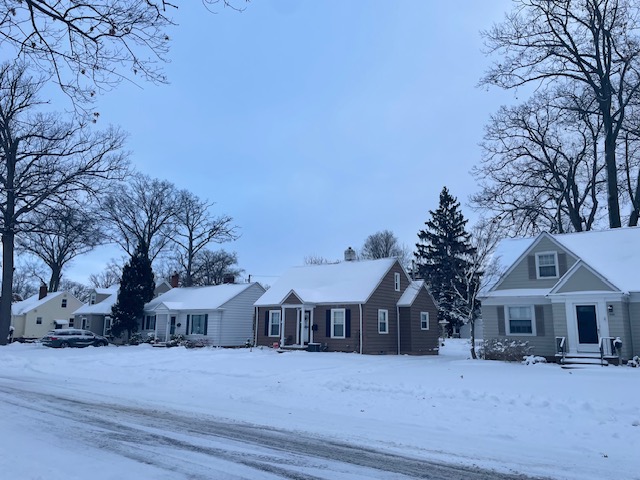
Once shaded, now open: In this row of Bay Village homes, the tree canopy no longer meets, leaving more sky than trees overhead.
Trees are stronger together. Healthy, well-maintained trees can live another 50 to 100 years. But when one goes, the others become more vulnerable—to storms, disease, and poor advice from companies that profit from removal rather than preservation.
Since moving in, I estimate that 25 trees have been removed from the houses closest to ours, including our own. We’ve replaced every tree we lost and even planted an extra maple that will one day shade my favorite sun-loving flower bed. It felt like a small, worthwhile concession.
I’ve heard that Bay has lost the equivalent of 238 football fields’ worth of canopy in the past 10 years. I can’t fully picture that—but I do notice how much more sky I see now above our houses. There’s a charming notion that a squirrel could once travel treetop to treetop for miles. While that may be more myth than fact, it does make me wonder: is there still even one street in Bay where a squirrel could make it from one end to the other without touching the ground?
 This spring, consider planting a tree—especially a canopy-scale tree. Consider buying one from the Bay Village Tree Conservancy. Aside from an initial watering commitment, the long-term work is minimal, and most of us will never see these trees at full maturity. But if our predecessors hadn’t planted with the future in mind, Bay wouldn’t look the way it does today.
If you have mature trees, have them assessed and cared for. If cost is a concern, reach out to us—we’ll do what we can. Planting, preservation, and education are at the heart of our work.
For those who want to do more, donations to the Bay Village Tree Conservancy help turn concern into action.
Trees are part of what makes Bay Village feel like Bay Village. Their quiet disappearance is something we need to notice, talk about, and address together.
To learn more or help support our mission, visit bvtrees.org.