 The Villager Newspaper Online Your Community News – Cleveland's Westshore

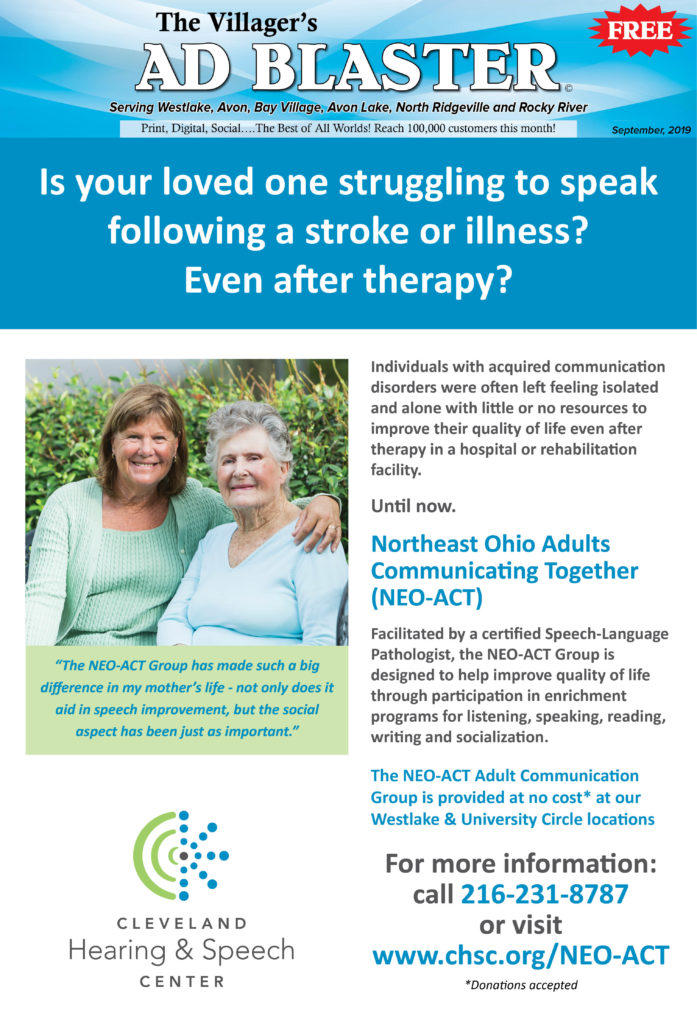
 September is Healthy Aging Month. In addition to diet and exercise, socialization (getting out and about, visiting with friends and family, volunteering, joining a group or club) is shown to be a key aspect of a healthy lifestyle. But what if you have trouble communicating? Stroke survivors or people dealing with chronic illness, such as Parkinson’s Disease, can feel isolated as they withdraw from social activities. Trying to communicate can be just too difficult for them, in spite of the joys they may be missing.
Cleveland Hearing & Speech Center (CHSC) recognizes the value of socialization and offers support for those who want to continue to enjoy group activities but need a place where they feel comfortable and confident. People like Linda Davis who suffered a stroke in 2015.
Though Davis was still able to speak after her stroke, words were difficult to retrieve from her memory. Davis was able to find support through the Northeast Ohio Adults Communicating Together (NEO-ACT program at CHSC.
“I haven’t found another program similar [to NEO-ACT anywhere esle] – nothing geared toward stroke survivors and people with brain injury,” Davis said.
CHSC Speech-Language Pathologist, Tracy Biller, who focuses on adults with acquired communication disorders, is the force behind the NEO-ACT program.
“What I’ve seen is that many outpatient programs for stroke survivors use a model in which participants sit passively and listen to a guest speaker.” Biller said. “I wanted to build a program that gives people a chance to practice conversation in a safe and welcoming environment.”
CHSC Director of Research, Dr. Rebecca Mental, said that research shows the importance of programs like NEO-ACT.
“Participation in these groups has been shown to lead to an increase in language skills, but, possibly more importantly, to social connections for individuals who might otherwise be relatively isolated,” Mental said. “This significantly affects quality of life for these individuals.”
For more information on NEO-ACT visit www.chsc.org/NEO-ACT or contact Tracy Biller at 216-325-7544 or tbiller@chsc.org.